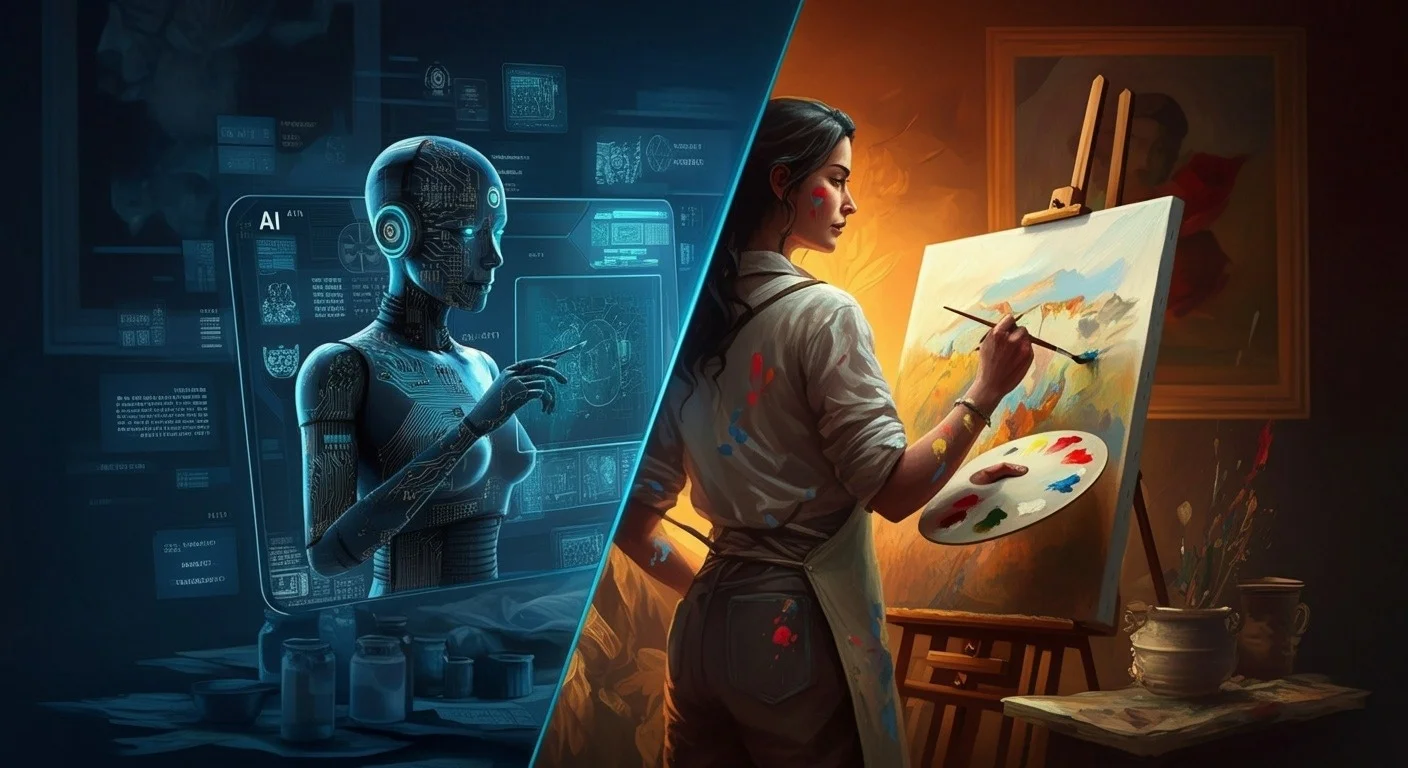
Digital marketing in 2026 is moving through one of its most important identity shifts. Artificial intelligence can now generate blog posts, ad headlines, product descriptions, email sequences, visuals, audience segments, and campaign recommendations in seconds. For marketers, that speed is exciting. It saves time, reduces repetitive work, and makes large-scale personalization possible. But it also raises a harder question: if AI can create so much content so quickly, where does human creativity still matter?
The short answer is that human creativity matters more than ever. The longer answer is that its role is changing. In modern digital marketing, AI is becoming a powerful engine for production, analysis, and optimization, while humans remain essential for strategy, emotional depth, cultural understanding, and brand meaning. The real challenge is not choosing AI or humans. It is building the right balance between them.
That balance matters because marketing is not just about producing content. It is about shaping perception, building trust, and moving people to act. AI can help generate a message, but it does not truly live inside a culture, feel tension in the market, or understand why one phrase feels authentic and another feels empty. It identifies patterns and predicts what may perform, but performance alone is not the same as resonance. A campaign can be technically correct and still emotionally forgettable.
This is why the “AI versus human creativity” debate is often framed the wrong way. In practice, the most effective marketers are not replacing human creativity with AI. They are redesigning creative workflows so each side does what it does best. AI is excellent at speed, scale, pattern recognition, and variation. Humans are stronger at storytelling, taste, empathy, nuance, ethics, and long-term brand thinking.
Consider what happens in a typical campaign. A team needs to research the audience, define the offer, write landing page copy, create social assets, test several ad angles, optimize for different channels, and monitor results. AI can accelerate many of those steps. It can generate draft concepts, suggest keyword clusters, create dozens of headline variations, summarize competitor content, and help teams test far more creative combinations than they could manually. That makes marketing faster and more efficient.
But efficiency is not the same as originality. One of the biggest risks of overusing AI in marketing is that brands begin to sound the same. If every team uses similar prompts, similar tools, and similar optimization logic, content starts to flatten. Messages become polished but generic. Visuals become clean but emotionally shallow. Campaigns become functional without becoming memorable. In a crowded digital environment, that sameness is dangerous because attention does not go to the most efficient message. It goes to the one that feels alive.
Human creativity protects against that flattening effect. It brings lived experience, intuition, humor, contradiction, and emotional intelligence into the process. A human creative director can sense when a campaign idea is safe but uninspired. A writer can understand when a sentence technically works but lacks rhythm or personality. A strategist can detect when a trend is popular but wrong for the brand. Those are not small details. They are often the difference between content that performs for a week and a brand voice that compounds over time.
This is especially important because marketing in 2026 is becoming more personalized and more automated at the same time. AI systems can now tailor messaging based on audience behavior, context, and performance signals, helping marketers deliver more relevant experiences at scale. That is a major advantage. Yet personalization without humanity can still feel mechanical. Consumers may receive the “right” message at the “right” time, but if the tone feels cold, overly synthetic, or emotionally off, the brand experience suffers.
That is where the perfect balance begins to emerge. AI should handle the work that benefits from speed, data, and repetition. Humans should lead the work that depends on meaning, sensitivity, and distinctiveness. In practical terms, AI can assist with ideation, research, draft generation, creative versioning, audience analysis, media optimization, and performance reporting. Human marketers should remain in control of positioning, voice, campaign themes, emotional framing, ethical boundaries, and final approvals.
This human-led model is becoming more important as marketers move from experimentation to operational use of AI. Gutenberg argues that in 2026, human-led AI marketing has become an operating requirement because teams need speed and consistency without losing human judgment. That insight captures the real issue well. The problem is not whether AI can produce work. It clearly can. The problem is how teams structure creative ownership so AI supports growth without weakening accountability, quality, or brand integrity.
A useful way to think about this balance is to separate creativity into layers. The first layer is generative creativity: producing many options quickly. AI is very strong here. It can offer headlines, taglines, hooks, outlines, visual prompts, and alternative angles in seconds. This is valuable because it removes blank-page paralysis and gives teams more directions to explore.
The second layer is selective creativity: deciding which idea is worth pursuing. Humans are much stronger here. Selecting the best concept requires context, taste, and an understanding of the brand’s broader narrative. A machine can rank outputs by likely engagement, but it cannot fully grasp what a brand should stand for in a shifting cultural landscape.
The third layer is expressive creativity: turning a good idea into something emotionally precise and distinctive. This is also deeply human. Brands do not win loyalty because they publish the highest volume of acceptable content. They win because they communicate in a way people remember, trust, and connect with. AI can support that expression, but human creators still shape the final emotional texture.
This does not mean AI weakens creativity. Used well, it can actually expand it. AI can help teams explore more concepts, stress-test assumptions, and break through repetitive thinking by surfacing patterns and combinations a human may not notice immediately. It can also free creative people from low-value production work, giving them more time for deeper thinking. In that sense, AI is not inherently the enemy of creativity. It becomes a problem only when teams mistake volume for originality or automation for insight.
There is also a strategic reason to preserve human creativity. Trust is becoming a central issue in AI-enabled marketing. StackAdapt notes that human oversight remains critical for brand safety, creative quality, and governance, especially as AI takes on a larger role in campaign execution. The same source also reports that over 70% of marketers have encountered AI-related issues such as hallucinations, bias, or off-brand content, while fewer than 35% plan to increase investment in AI governance or brand integrity oversight in 2026. That gap should concern any serious marketer.
Why? Because creativity is not just an output problem. It is also a risk-management problem. A campaign that feels tone-deaf, culturally unaware, or too synthetic can harm brand perception faster than it improves efficiency. Human review is not a bottleneck to be eliminated. It is a quality filter that protects trust. In sectors like healthcare, finance, education, and public services, that filter is even more important because the cost of misleading or insensitive messaging is higher.
The most effective digital marketing teams are therefore moving toward a hybrid workflow. They use AI early and often, but not blindly. AI helps them research, brainstorm, draft, personalize, and optimize. Humans define the brief, shape the strategic message, choose the emotional direction, refine the language, and decide what goes live. This model is both faster and more resilient than either extreme.
For example, a brand launching a new product might use AI to analyze customer reviews, identify recurring pain points, generate initial ad variations, and personalize follow-up emails by segment. But the central campaign idea, the emotional promise, the visual identity, and the final storytelling arc should still be led by humans. That combination gives the team both scale and soul.
In many ways, the future of digital marketing belongs to creative systems rather than isolated tools. The winning organizations will not be those that publish the most AI-generated assets. They will be the ones that know where automation creates leverage and where human judgment creates differentiation. They will treat AI as a collaborator, not a substitute. They will build workflows where machines accelerate execution while humans protect meaning.
So, what is the perfect balance in digital marketing? It is not 50-50 in every task. It is role clarity. Let AI do what it is best at: processing data, generating options, scaling production, and optimizing patterns. Let humans do what they are best at: understanding people, making creative leaps, setting direction, and deciding what deserves to represent the brand in public.
The brands that find this balance will not only move faster. They will sound more human in a market increasingly filled with synthetic noise. And in 2026, that may be the most valuable creative advantage of all.